

Every B2B buyer sourcing metal zippers eventually asks the same question: what am I actually paying for? Understanding the manufacturing process — from raw alloy ingots to a finished, tested zipper — is the difference between ordering a commodity and specifying a component that adds measurable value to your product. This guide walks you through all seven stages of metal zipper production, so you can evaluate suppliers with confidence and spot quality issues before they become warranty claims.
Garment manufacturers, bag and luggage brands, outdoor gear producers, upholstery buyers, and procurement managers who want to understand metal zipper production to make better sourcing decisions, negotiate from knowledge, and spot quality risks before placing bulk orders.
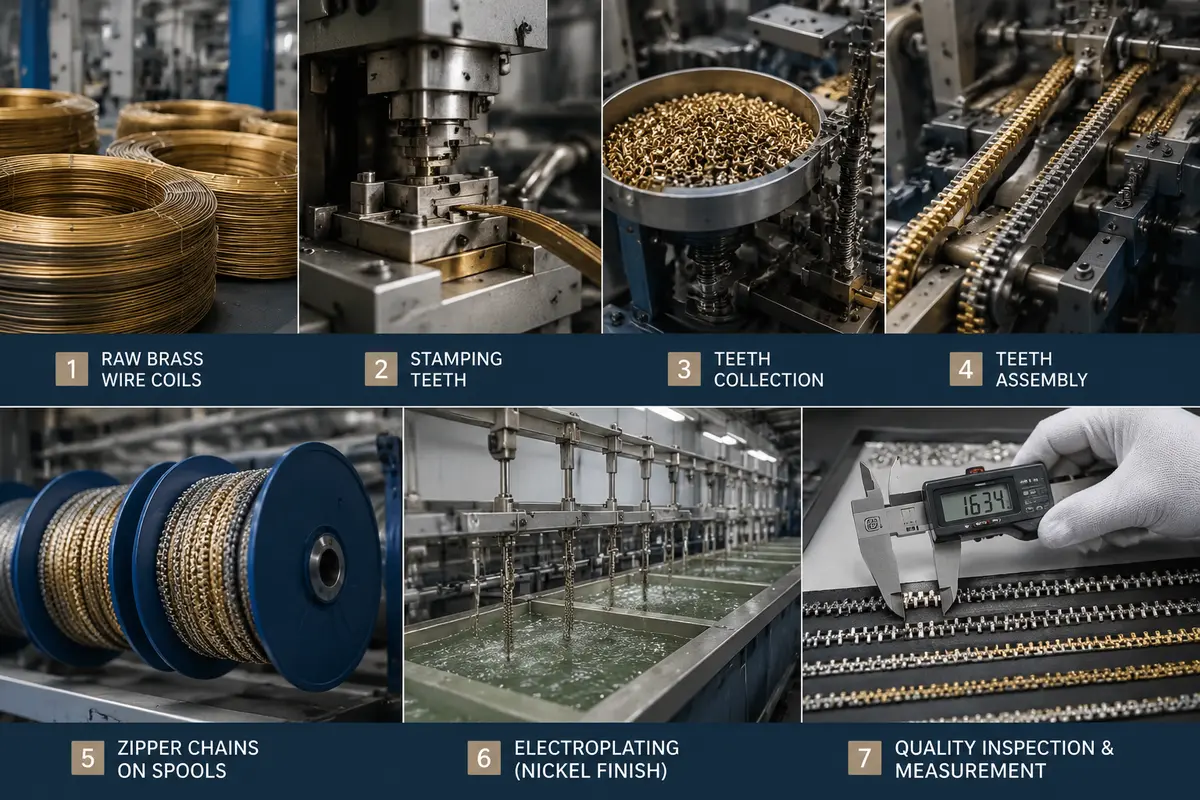
The 7-Stage Manufacturing Process at a Glance
| 1 | Raw Material Preparation | Alloy casting, wire drawing, tape weaving |
| 2 | Teeth Forming | Stamping or die-casting individual zipper teeth |
| 3 | Teeth Mounting on Tape | Clamping teeth onto polyester/nylon tape at precise spacing |
| 4 | Surface Treatment | Electroplating, polishing, antiquing, or coating |
| 5 | Slider Assembly | Die-casting slider body + assembling pull tab, spring, locking pin |
| 6 | Final Assembly & Stops | Attaching top/bottom stops, threading slider, cutting to length |
| 7 | Quality Inspection & Packaging | Functional testing, visual inspection, dimensional checks, packing |
Stage 1: Raw Material Preparation — Where Quality Begins
Metal zipper production starts with three primary raw materials, and the alloy grade chosen at this stage determines everything downstream — strength, corrosion resistance, cost, and machinability.
Copper-zinc alloy (typically 65/35). Naturally golden, self-lubricating, excellent corrosion resistance. Preferred for jeans, jackets, premium garments. Cost: highest of the three.
Zamak (Zn-Al-Mg-Cu). Excellent castability, strong when die-cast. Requires electroplating for corrosion resistance and appearance. Cost: most economical.
Lightweight, naturally corrosion-resistant. Softer than brass — best for lightweight bags and non-load applications. Cost: mid-range.
Meanwhile, polyester or nylon tape is woven on high-speed looms. Polyester dominates for garments (washable, shrink-resistant); nylon offers higher tensile strength for heavy-duty applications like luggage and outdoor gear.
Ask your supplier which alloy grade they use — not just "brass" or "zinc." Brass should be 65/35 Cu/Zn minimum; zinc alloy should be Zamak #3 or #5. Sub-grade alloys save the factory pennies but cost you in returns. Also confirm tape material (polyester vs nylon) and denier rating — this affects wash durability and tensile strength.
Stage 2–3: Teeth Forming & Mounting — The Heart of the Zipper
This is where metal zipper manufacturing diverges from nylon coil or plastic molded zippers. Two methods dominate:
Brass or aluminum wire is first rolled flat, then fed into a high-speed stamping press. Each stroke of the die cuts and forms one tooth — a Y-shaped profile with clamping legs. The tooth is immediately clamped onto the zipper tape edge at precise spacing (typically 2.5–4.0mm pitch depending on gauge). Production speed: 800–1,500 teeth per minute.
Molten zinc alloy is injected under high pressure into a multi-cavity steel mold. Each shot produces multiple teeth that are simultaneously cast directly onto the tape. This method is faster than stamping and produces teeth with more complex geometries, but requires precise temperature control — overheating weakens the tape, under-heating causes incomplete filling.
Critical specification: Tooth pitch (spacing between teeth centers) determines zipper gauge. Standard pitches: #3 = 2.5mm, #5 = 3.0mm, #8 = 4.0mm, #10 = 4.5mm. Even a 0.1mm deviation causes meshing problems and premature wear. Quality manufacturers maintain ±0.02mm tolerance on tooth spacing — ask for this in your supplier's QC documentation.
Stage 4: Surface Treatment — Electroplating, Polishing & Finishing
After teeth are mounted, the zipper chain undergoes surface treatment. For zinc alloy teeth, electroplating is essential — the raw metal has poor corrosion resistance and an unattractive gray appearance. Brass teeth are often polished or antiqued rather than plated.
| Nickel Plating | Bright silver finish. Cost-effective, good corrosion resistance. Most common finish for zinc alloy teeth. Minimum 3μm thickness recommended. |
| Antique Brass Plating | Warm, aged golden tone. Popular on jeans, heritage-style bags, and premium leather goods. Applied over a nickel undercoat. |
| Gunmetal (Black Nickel) | Dark, matte charcoal finish. Modern and understated — popular on tactical gear, premium luggage, and contemporary fashion. |
| Brushed Brass (Natural) | Mechanical brushing of natural brass teeth — no plating. Develops patina over time. Valued in premium denim and heritage goods. |
| Electrophoretic Coating | Paint-like coating applied via electrical current. Available in any color. Adds a protective layer — good for outdoor gear requiring specific color matching. |
Buyer's note: Post-plating, zippers must be thoroughly rinsed and neutralized. Residual plating chemicals cause delayed corrosion — a zipper that looks perfect on delivery may show white rust within 3 months. Insist on 24-hour salt spray test (ISO 9227) certification from your supplier.
Stage 5–6: Slider Assembly & Final Zipper Assembly
Sliders are manufactured separately — typically via zinc alloy die casting for the body, with a steel spring and locking pin mechanism for auto-lock types. The pull tab (puller) can be the same material or a different finish for design contrast.
Final zipper assembly involves:
Top & Bottom Stops
Metal stops are clamped onto the tape ends. Top stops prevent the slider from coming off; bottom stops create the starting point for engagement.
Slider Threading
The slider is threaded onto the zipper chain through a machine that separates the teeth, positions the slider, and releases.
Cutting to Length
The continuous zipper chain is cut to specified lengths ±2mm tolerance. Custom lengths are cut per order; standard lengths are pre-cut for stock.
Stage 7: Quality Inspection — The Gatekeeper
A factory's inspection protocol reveals more about product quality than any brochure. Here's what a thorough QC process looks like at each checkpoint:
| Incoming Material Inspection | Alloy composition verification; tape tensile strength test; plating chemical batch check |
| In-Process Inspection | Tooth spacing measurement (sample every 30 min); plating thickness monitoring; slider dimension check |
| Functional Testing | Open/close cycle test (5,000 cycles minimum); lateral pull strength test; slider locking force test |
| Salt Spray Testing | 24–48 hour neutral salt spray (ISO 9227) on plated components — no white rust permitted |
| Final Visual Inspection | Color consistency under D65 lighting; surface defect check (burrs, scratches, uneven plating); length confirmation |
Quality factories use AQL (Acceptable Quality Limit) sampling per ISO 2859-1. For zippers, the industry standard is AQL 2.5 for major defects and AQL 4.0 for minor defects. If your supplier cannot tell you their AQL levels, they're likely doing ad-hoc inspection — a red flag for bulk orders.
How This Knowledge Translates to Better Sourcing
Understanding the manufacturing process gives you leverage at every stage of procurement:
When a supplier quotes \$0.08/unit vs \$0.12/unit, you can ask: "What alloy are you using? What plating thickness? What AQL level?" A 1μm difference in nickel plating cuts cost — and lifespan — significantly.
Walk the production floor and check: Are tooth-stamping dies well-maintained or worn? Is the plating line clean? Are inspection stations staffed? The process doesn't lie — if stages are skipped or rushed, the product will show it.
Know that electroplating alone adds 1–2 days. Custom slider molds add 7–10 days for fabrication. A supplier promising custom zippers in 3 days is either skipping steps or lying about customization.
Your RFQ can now specify alloy grades, tape materials, plating thickness, tooth pitch tolerances, and inspection standards — not just "5,000 metal zippers, #5, nickel finish." Precision in your spec forces precision in their production.
The Bottom Line
A metal zipper looks simple. But behind every one-cent unit price difference is a decision about alloy purity, plating thickness, tooth tolerance, and inspection rigor. When you understand the seven stages of production, you stop buying zippers on price and start specifying them on performance.
- What alloy grade do you use for teeth (Brass 65/35? Zamak #3 or #5? Aluminum 5052?)
- What is your tooth pitch tolerance? (Acceptable: ±0.02mm)
- What plating thickness do you guarantee? (Minimum: 3μm nickel, 1μm brass)
- Can you provide salt spray test reports per ISO 9227?
- What AQL level do you inspect to? (Industry standard: AQL 2.5/4.0)
- What is your cycle-life guarantee? (Minimum: 5,000 open/close cycles)
Ready to source metal zippers from a manufacturer that can answer all six questions? Request a factory tour video and detailed specification sheet — and let's talk about your next production run.